gdi 2026
Several Journal Special Issues and Book Chapters
|
Entirely Online
|
Several Journal Special Issues and Book Chapters | Entirely Online |

GDI2026 will be organized in collaboration with DigiBUILT2026
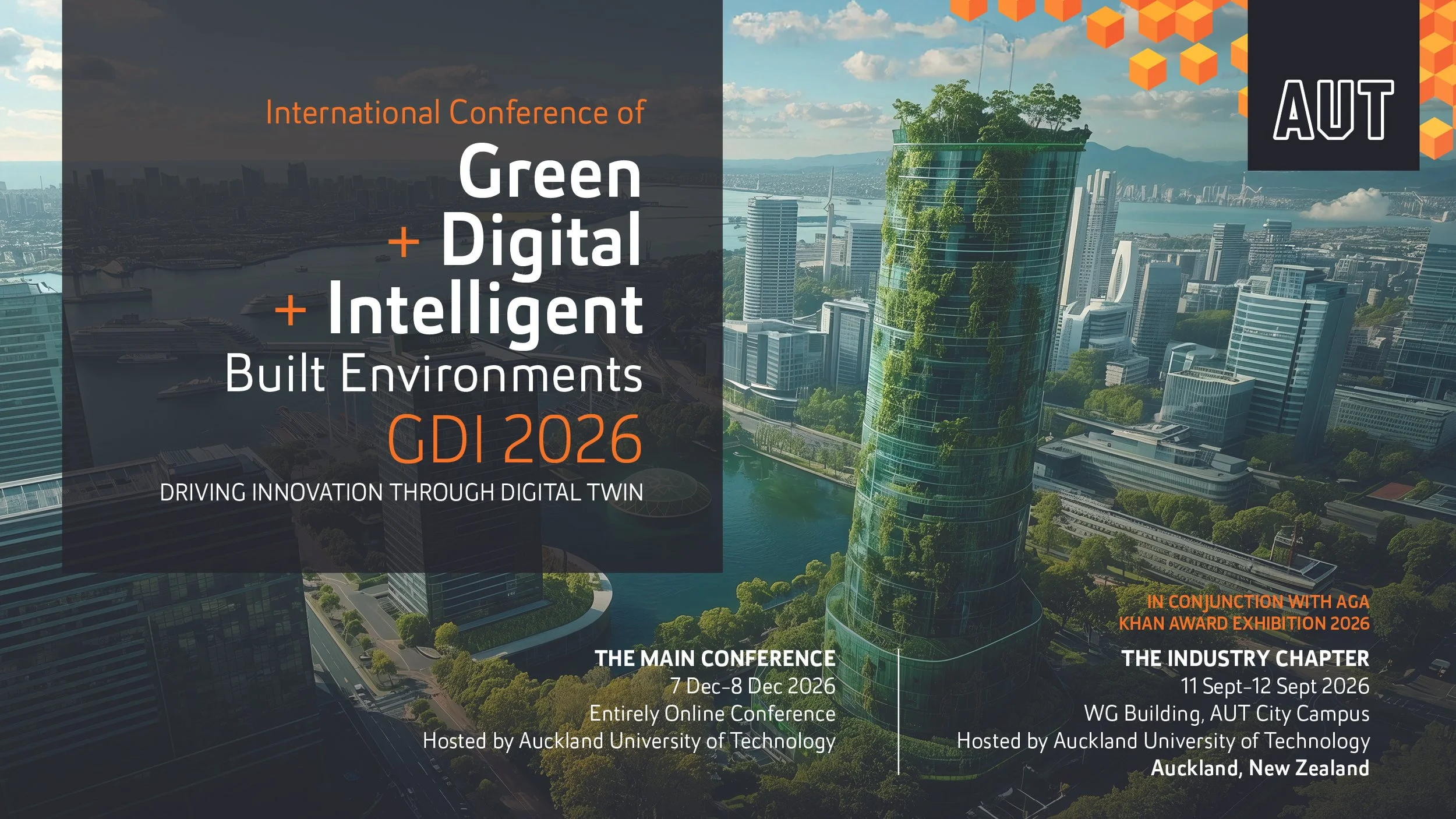
The International Conference of Green + Digital + Intelligent Built Environments (GDI 2026) builds on the outstanding success of GDI 2025, continuing a vital international dialogue on innovation in design, construction, and sustainable development.
We are completely aware of the complexities and uncertainties within the current global geopolitical landscape. In response to these challenges, and to ensure equitable access, certainty, and uninterrupted participation for our global community, we have made the decision to host the main GDI 2026 conference entirely online from 7–8 December 2026 with substantially reduced registration fees.
As a precursor to the main digital event, the GDI 2026 Industry Chapter will be organised as an in-person gathering from 11–12 September 2026. This will run in conjunction with the Aga Khan Award Exhibition 2026, proudly hosted by the School of Future Environments at Auckland University of Technology in Auckland, New Zealand.
Operating in this highly accessible virtual format, GDI 2026 will once again bring together academics, industry leaders, and practitioners from around the world to share cutting-edge research, real-world applications, and forward-looking ideas shaping the future of the built environment.
Join us online at GDI 2026 as we build upon last year’s momentum, strengthen global collaboration, and continue redefining what is possible in green, digital, and intelligent building practices.
GDI2026 themes
Regenerative & Climate-Positive Built Environments
1.1 Net-Zero & Beyond: Carbon-Positive Design & Construction
- Whole-life carbon accounting & embodied carbon reduction strategies
- Carbon-sequestering materials (mass timber, hempcrete, bio-composites)
- Net-positive building certifications & policy frameworks
- Carbon budgets at building, precinct & city scale
- Carbon markets & offset mechanisms in construction
1.2 Regenerative Architecture & Biophilic Design
- Regenerative design principles beyond sustainability
- Living walls, green roofs & ecosystem-integrated architecture
- Biophilic design for health, productivity & mental well-being
- Nature-based solutions for urban heat, flooding & biodiversity
- Rewilding the city: urban ecology & habitat corridors
1.3 Climate Adaptation & Extreme-Event Resilience
- Designing for floods, wildfires, heatwaves & sea-level rise
- Passive resilience: thermal mass, natural ventilation & flood-proofing
- Climate risk assessment & scenario-based design
- Community resilience & post-disaster reconstruction
- Urban heat island mitigation & cool city strategies
1.4 Circular Economy & Post-Carbon Construction
- Material passports, design for disassembly & end-of-life planning
- Deconstruction, reuse & urban mining of construction materials
- Bio-based & rapidly renewable building materials
- Waste-to-resource construction value chains
- Policy levers & regulatory frameworks for circular construction
Advanced Materials, Structures & Construction Innovation
2.1 Next-Generation Smart & Programmable Materials
- Self-healing concrete, polymers & biological repair systems
- Stimuli-responsive materials (thermochromic, piezoelectric, shape-memory)
- Phase-change materials for passive thermal regulation
- Nano-engineered construction materials & coatings
- Multi-functional materials combining structure, sensing & energy generation
2.2 High-Performance & Adaptive Structural Systems
- Ultra-high-performance concrete (UHPC) & fibre-reinforced composites
- Seismic-resilient, base-isolated & rocking systems
- Tensegrity, auxetic & morphing structural architectures
- Design for extreme loads: tsunamis, blasts & Arctic conditions
- Structural topology optimisation for material efficiency
2.3 3D Printing, Additive Manufacturing & Robotic Fabrication
- Large-scale concrete & metal 3D printing for construction
- Additive manufacturing of complex architectural geometries
- Robotic on-site assembly & prefabrication
- Multi-material printing for integrated structural-functional systems
- Regulatory, quality & standardisation challenges in printed construction
2.4 Resilient Ground, Geotechnics & Underground Urbanism
- Foundation design for subsidence, liquefaction & extreme climate
- AI-assisted geohazard risk assessment & slope stability
- Underground cities, networks & climate-adaptive subterranean spaces
- Carbon sequestration & geothermal energy in urban geology
- Geo-synthetics & self-healing materials for ground reinforcement
Human-Centred Design, Health & Social Equity
3.1 Neuroarchitecture & Evidence-Based Design
- Neuroscience of space: how the built environment shapes cognition & emotion
- Sensory design: light, acoustics, texture & spatial experience
- Designing for neurodivergent populations & cognitive accessibility
- Stress reduction, creativity & productivity in designed environments
- Psychologically informed design for hospitals, schools & workplaces
3.2 Housing Affordability, Equity & Social Infrastructure
- Global housing crisis: policy, delivery & innovation responses
- Community land trusts, co-housing & non-market housing models
- Design of social infrastructure: schools, health centres & community hubs
- Inclusive design for ageing populations & people with disabilities
- Indigenous & culturally responsive housing design
3.3 Heritage, Cultural Identity & Adaptive Reuse
- Heritage conservation in the age of climate change & digital disruption
- Adaptive reuse strategies for embodied carbon retention
- Indigenous design knowledge & place-based cultural identity
- Post-conflict & post-disaster heritage reconstruction
- Community memory, storytelling & participation in heritage design
3.4 Healthy & Productive Indoor Environments
- Indoor air quality, ventilation & post-COVID design evolution
- Circadian lighting design & its effects on occupant health
- Thermal comfort, acoustic privacy & biophilic indoor environments
- Workplace & school design for cognitive performance
- Certification systems: WELL, Fitwel & health-based design standards
Construction Practice, Governance & the Future Workforce
4.1 Construction Management, Procurement & Project Delivery
- Integrated project delivery, alliancing & relational contracting
- Lean, agile & last-planner approaches in complex projects
- Value-based & social-value procurement frameworks
- Supply chain transparency, resilience & local industry development
- Indigenous & SME supplier engagement & capacity building
4.2 Workforce Futures, Safety & Culture
- Mental health, psychosocial safety & culture in construction
- Gender equity, diversity & inclusion on the jobsite & in leadership
- Future skills, trades transformation & workforce development
- Smart wearables & real-time hazard detection for worker safety
- Apprenticeship reform & vocational education for the green transition
4.3 Policy, Regulation & Built Environment Governance
- Net-zero building codes, regulations & compliance frameworks
- Planning system reform for climate-adaptive & inclusive cities
- Cross-sector governance for infrastructure resilience
- International policy benchmarking in sustainable construction
- Financing mechanisms: green bonds, ESG in construction & public-private partnerships
4.4 Design Education, Research Practice & Knowledge Transfer
- Pedagogical innovation in architecture, engineering & construction education
- Practice-research integration & industry-embedded research models
- Interdisciplinary design studios & collaborative knowledge production
- Global South perspectives & decolonising built environment education
- Open science, research reproducibility & knowledge equity in construction
Digital Futures & the Built Environment
5.1 Digital Equity, Access & the Right to the Connected Environment
- Digital exclusion and its spatial consequences across urban, regional and rural communities
- Connectivity infrastructure as essential public utility: access, affordability and governance
- The digital divide in housing: who benefits from smart building technologies and who does not
- Indigenous and remote community rights in the digitally connected built environment
- Inclusive design principles for digitally integrated spaces across all socioeconomic contexts
5.2 Living & Working in Digitally Transformed Environments
- The human experience of sensor-rich, data-driven and algorithmically managed buildings
- Occupant autonomy, privacy and agency in intelligent built environments
- Changing patterns of inhabitation: remote work, hybrid space and the dissolution of building typologies
- Digital wayfinding, ambient interfaces and the sensory experience of connected space
- Psychosocial dimensions of living alongside autonomous and AI-mediated building systems
5.3 Digital Infrastructure, Territory & the Physical Footprint of the Digital World
- The spatial and environmental consequences of data centres, server farms and digital energy demand
- Telecommunications infrastructure as a shaping force on building and landscape design
- Carbon, water and land impacts of the physical infrastructure underpinning digital built environments
- Rural and regional territory in the age of satellite connectivity and distributed digital infrastructure
- Planning and design responses to the material demands of an increasingly digital civilisation
5.4 Governance, Culture & Community in the Digital Built Environment
- Community rights, data sovereignty and democratic governance of digitally instrumented places
- Cultural identity and heritage in environments increasingly mediated by digital overlays
- Ethical frameworks for algorithmic decision-making in planning, housing and infrastructure policy
- Trust, transparency and public participation in the governance of smart places
- Decolonising digital urbanism: Indigenous data sovereignty and culturally grounded approaches to digital place